China Best Artificial Sky Manufacturers?
Choosing the China Best Artificial Sky Manufacturers requires more than comparing attractive showroom photographs. An Artificial Sky is a technical installation involving lighting, structure, software, acoustics, and long-term maintenance. A convincing ceiling may use LED panels, fiber optics, or customized digital displays. Each solution creates a different atmosphere. It also creates different costs, service needs, and installation risks.
This guide examines Chinese manufacturers through practical criteria, including engineering experience, production capability, optical quality, control systems, and after-sales support. A reliable supplier should explain brightness levels, color temperature, pixel pitch, power consumption, heat management, and access for repairs. Ask for project references with similar ceiling dimensions. A hotel lobby, medical facility, retail store, and private residence do not need identical systems. Small details matter. A ceiling that looks beautiful at night may feel harsh during daytime operation. That difference is easy to overlook.
Manufacturing evidence also deserves attention. Buyers should review material specifications, quality-control procedures, testing records, and installation guidance before signing a contract. Certifications can support credibility, but they do not replace technical verification. No single company is automatically the best for every project. The right choice depends on budget, climate, ceiling height, visual goals, and local service availability. Some comparisons may remain imperfect because suppliers present information differently. That is worth admitting. A careful evaluation can still identify manufacturers with dependable craftsmanship, responsive communication, and realistic delivery commitments. The goal is not merely a brighter ceiling. It is a stable, maintainable, and believable sky effect that performs well after the showroom lights disappear.
Artificial Sky Systems: Definition, Components, and 6,500K Daylight Standards
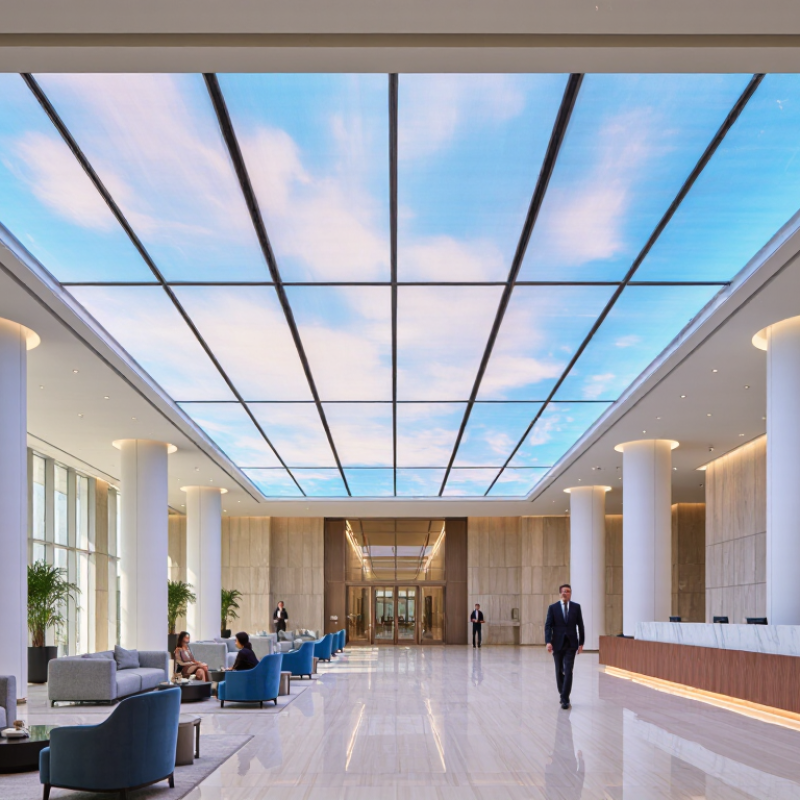
Artificial sky systems recreate the visual experience of open daylight indoors. They usually combine LED modules, optical diffusers, reflective cavities, sensors, and programmable controls. A well-designed ceiling panel can show a blue-sky appearance while delivering stable, comfortable illumination across desks and walkways.
The 6,500K figure refers to correlated colour temperature, not a universal daylight requirement. CIE publications identify D65, approximately 6,500K, as a daylight reference illuminant for colour evaluation. It does not mean every occupied room should remain at 6,500K all day. Research and guidance from the Illuminating Engineering Society support considering illuminance, glare, colour rendering, and visual comfort together. A system may use brighter, cooler light in the morning, then reduce intensity and warmth later. That feels more natural.
Details matter. A diffuser should prevent visible LED points, especially when viewed from an angle. Sensors can measure daylight, occupancy, and panel temperature. Controls should respond without sudden jumps. The International Energy Agency has reported that lighting uses roughly 15% of global electricity, so efficient LEDs and automatic dimming deserve serious attention. Yet energy savings alone do not prove quality. Poor calibration can create blue discomfort, uneven ceilings, or false sky depth. I have seen specifications focus heavily on 6,500K while ignoring flicker and maintenance access. That is a costly oversight. Performance should be verified with measured lux, CCT, colour rendering, glare assessment, and documented commissioning records.
Artificial Sky Systems: CIE Daylight Reference Standards
Artificial sky systems reproduce controlled daylight conditions for visual evaluation, photography, material testing, and color research. The chart compares internationally recognized CIE standard illuminants by correlated color temperature (CCT). D65, approximately 6,500 K, is widely used as a daylight reference.
CCT describes the apparent color of a light source and does not define illuminance, spectral power distribution, or uniformity. A complete artificial sky system also requires a calibrated light source, diffuser or sky panel, control system, optical enclosure, and measurement instruments.
China’s Artificial Sky Market: LED Efficacy Above 100 lm/W and 50,000-Hour Life
China’s artificial sky market is moving toward LED systems with efficacy above 100 lm/W and rated lives near 50,000 hours. These figures can reduce energy use and replacement work in large indoor spaces. However, buyers should check whether efficacy refers to the LED chip, module, or complete ceiling system. Diffusers, optics, drivers, and control equipment can lower real output.
Tips: Request photometric reports, color-rendering data, flicker limits, and thermal test records. Ask how the 50,000-hour rating was calculated. It often means projected L70 life, not guaranteed failure-free operation. Review LM-80 and TM-21 evidence where available. Also inspect sample panels under ordinary room conditions, not only in a showroom.
Reliable manufacturers usually explain testing methods, warranty limits, maintenance access, and driver replacement procedures. A strong supplier can provide uniformity maps and measured illuminance at the working plane. Check whether the system maintains stable color after long operation. A perfect specification can still disappoint. In practice, ceiling height, dust, ventilation, and installation quality affect performance. Some projects also need daylight scenes, cloud movement, or circadian controls, which may reduce efficiency. Clear drawings and responsive engineering support matter as much as headline numbers.
Procurement Guide: Comparing Warranty Terms, Energy Use, and Installation Costs
China Best Artificial Sky Manufacturers?
Procurement should begin with warranty language, not showroom brightness. A credible supplier should state coverage for LEDs, drivers, controls, and diffuser panels separately. Five years is common for commercial lighting, but exclusions matter more than the headline number. Ask whether labor, replacement shipping, and color-shift failures are included. The U.S. Department of Energy notes that LED lifetime often exceeds 50,000 hours, yet electronics can fail earlier under heat. That difference deserves written protection.
Energy use is easier to compare when suppliers provide installed watts per square meter. The International Energy Agency reports that lighting consumes about 15% of global electricity. An artificial sky using efficient LEDs, daylight sensors, and occupancy controls can reduce unnecessary operating hours. DOE research commonly places quality LED efficacy above 100 lumens per watt, but real systems lose output through optics and diffusion. Request independent test reports, not only laboratory claims. A bright ceiling can still be wasteful.
Installation cost is often underestimated. Include ceiling reinforcement, electrical circuits, control commissioning, access equipment, and future panel replacement. Labor conditions vary widely across Chinese manufacturing regions and overseas sites. A prefabricated modular frame may shorten installation, but transport damage remains a risk. I would budget a contingency of 10% to 15%, then challenge it with site measurements. This is not excessive caution. It reflects the uncomfortable gap between a factory quotation and a finished ceiling. EPA and DOE lifecycle-cost guidance supports comparing purchase, energy, maintenance, and disposal costs together.

 Sensor
 Measuring Instruments
 Measurement Systems
 Architectural Physics Laboratory