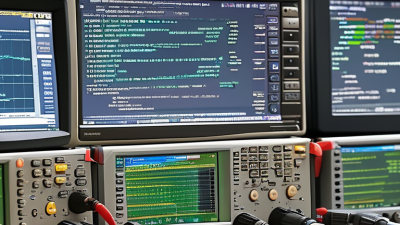
Modern laboratories and production lines are measuring more signals in less space. Multi-Channel Measuring Instruments help engineers monitor voltage, current, temperature, vibration, and frequency together. A single synchronized setup can reveal timing errors that separate meters may hide.
The market is expanding. MarketsandMarkets estimated the global electronic test and measurement market at about USD 25 billion in 2023, with continued growth expected through 2028. Deloitte’s 2023 Smart Manufacturing and Operations Survey also found that 86% of manufacturing leaders considered smart factory initiatives important for competitiveness. These figures suggest stronger demand for connected, accurate, and efficient measurement systems. However, market growth does not guarantee a suitable purchase.
Specifications can be misleading.
A high channel count may increase noise, reduce sampling speed, or complicate software control. Engineers should examine simultaneous sampling, bandwidth, resolution, isolation, synchronization, calibration support, and long-term operating costs. NIST guidance on measurement traceability reinforces a practical point: reliable results depend on documented calibration and an unbroken link to recognized standards. This article presents seven practical tips for choosing Multi-Channel Measuring Instruments, from defining signal requirements to checking interface compatibility and after-sales service. It also considers real workshop details, such as crowded test benches, long sensor cables, heat near power electronics, and operators who need clear data quickly. No instrument is perfect. A careful comparison can still prevent expensive surprises.

Choosing a multi-channel measuring instrument starts with a clear measurement plan. List every signal, sensor type, expected range, and required accuracy. Include temperature, voltage, current, vibration, or pressure inputs separately. Each channel may need different conditioning. A shared input setting can create avoidable errors.
Count current channels, then examine future needs. Leave practical space for expansion. I once selected a system with just enough channels, and one added sensor forced a redesign. My early estimate was too optimistic. Check the sampling rate for each signal, not only the advertised maximum. Fast vibration data needs very different performance from slow temperature logging. Synchronization also matters when comparing events across several sensors.
Review channel isolation, connector safety, grounding, and software capacity. Separate channels can reduce interference between noisy and sensitive measurements. Confirm whether all channels can sample simultaneously. Some systems switch inputs quickly instead, which may distort short events. Ask for uncertainty data, calibration procedures, and test conditions. Do not rely on a single impressive specification. Verify the figures with technical documents and, when possible, a controlled bench test. Record the sensor output beside the instrument reading. That simple comparison often exposes wiring mistakes, incorrect scaling, or an overlooked delay. Recheck the plan after the first trial. Real equipment rarely behaves exactly like a spreadsheet.
7 Tips for Choosing Multi Channel Measuring Instruments
When choosing a multi-channel measuring instrument, start with the measurement you need to trust. Accuracy describes closeness to the true value, while resolution describes the smallest visible change. They are related, but not interchangeable. A display showing 0.001 volts may still be inaccurate by 0.02 volts. Check accuracy across the full input range, not only the attractive center of the specification sheet. Temperature, lead resistance, signal noise, and channel loading can shift results during real testing.
Measurement speed needs equal attention. A fast scan rate is useful only if readings settle before capture. Ask whether the instrument measures every channel continuously or switches between them. A switching system may miss short pulses, especially when source impedance is high. During evaluation, connect a stable reference, a changing signal, and a weak signal. Record settling time and repeatability, not just the maximum samples per second. That test revealed a weakness in my own comparison. I focused on peak speed and overlooked relay transition delays.
For dependable work, compare uncertainty, resolution, and speed under identical conditions. Request calibration records and verify the stated accuracy period. Look for guarded inputs, clear overload limits, and software timestamps. These details support traceability when several channels produce conflicting values. A practical choice balances readable changes with honest accuracy and sufficient capture speed. The most impressive specification may not suit a slow, noisy sensor.
7 Tips for Choosing Multi Channel Measuring Instruments
Check Signal Compatibility and Input Flexibility
Signal compatibility should be your first practical check. A modern test bench may combine voltage, current, temperature, strain, and frequency signals. Each channel needs the correct range, connector, isolation, and sampling method. A high channel count means little if one input clips a 24-volt pulse.
MarketsandMarkets reported that the global test and measurement equipment market could grow from about 28 billion dollars in 2024 to over 36 billion dollars by 2029. This expansion reflects more connected systems and denser measurement tasks. However, buying capacity without checking signal behavior creates expensive gaps. Verify whether inputs accept single-ended and differential signals. Check thermocouple support, bridge excitation, bandwidth, and simultaneous sampling. Small details matter.
I once tested a compact system that accepted many sensors but lacked flexible input configuration. The readings looked stable. They were not fully comparable. This was my mistake. Shared grounding introduced a quiet offset between channels. IEC 61000-4-2 guidance also reminds engineers to consider electrostatic discharge during equipment evaluation. Ask for documented accuracy, input impedance, isolation voltage, and calibration intervals. Do not rely only on a product table. Connect your real sensor cables, add the longest expected lead, and inspect the waveform at low and high levels. A few minutes of hands-on checking can expose noise, aliasing, or connector limitations. Some specifications still need questioning.
| No. | Selection Tip | Key Specification to Check | Practical Compatibility Check | Typical Engineering Guidance | Why It Matters |
|---|---|---|---|---|---|
| 1 | Match the Input Type to the Signal | Voltage, current, resistance, frequency, thermocouple, RTD, strain-gauge, or bridge input | Confirm that every sensor output is supported directly or through the required signal conditioning. | Common industrial signal levels include 0–10 V and 4–20 mA; sensor-specific inputs may require excitation and linearization. | Prevents incorrect readings, overloads, and the need for extra converters. |
| 2 | Verify Input Range and Protection | Minimum and maximum measurable value, overload rating, and input impedance | Compare the highest expected signal, transient level, and sensor output with the instrument limits. | Select a range above the normal maximum while keeping the signal large enough to use the available resolution. | Protects the measurement input and reduces clipping or loss of useful resolution. |
| 3 | Choose the Right Channel Count | Number of analog channels, digital channels, and expandable modules | Count all required sensors, reference channels, trigger inputs, and spare channels for future testing. | Allowing approximately 10–20% spare capacity can reduce rewiring when the test setup changes. | Supports system expansion and avoids using multiple unsynchronized instruments. |
| 4 | Check Sampling Rate and Bandwidth | Per-channel sampling rate, analog bandwidth, filtering, and simultaneous or multiplexed sampling | Identify the highest signal frequency and select a sampling rate that captures its waveform without aliasing. | For periodic signals, sampling above twice the highest frequency is the theoretical minimum; higher rates are preferred for practical filtering and waveform accuracy. | Preserves signal shape and timing relationships across channels. |
| 5 | Evaluate Resolution and Accuracy | ADC resolution, gain accuracy, offset error, noise, drift, and calibration interval | Compare the smallest change that must be detected with total measurement uncertainty over the operating temperature range. | A 16-bit converter provides 65,536 quantization levels, but actual effective resolution is reduced by noise and other errors. | Ensures that small variations are measurable and results remain defensible. |
| 6 | Confirm Channel Synchronization and Isolation | Channel-to-channel isolation, common-mode range, synchronization method, and timing skew | Check whether channels share a ground, whether sources are floating, and whether measurements must be time-aligned. | Simultaneous sampling is generally preferable for phase, vibration, transient, and multi-sensor correlation tests. | Reduces ground-loop risk and improves the reliability of cross-channel analysis. |
| 7 | Review Data Handling and Environmental Limits | Storage capacity, communication interface, export formats, trigger functions, operating temperature, and ingress protection | Estimate data volume using: channels × samples per second × bytes per sample × test duration. | For example, 8 channels × 10,000 samples/s × 2 bytes × 60 s requires about 9.6 MB before file overhead and metadata. | Ensures reliable operation, efficient transfer, and complete test records in the intended environment. |
Selection principle: Choose an instrument whose input type, range, bandwidth, synchronization, accuracy, and environmental ratings meet the most demanding measurement in the test system.
When choosing multi-channel measuring instruments, synchronization deserves close attention. A small timing error can distort vibration, temperature, or pressure comparisons.
Software should reduce mistakes, not create new ones.
Tip: Test the software with your normal workflow. Import files, change sampling rates, and repeat a measurement.
I once trusted a clean graph too quickly; the export had missing values.
Data handling affects long-term reliability.
These checks may feel excessive. They are not.
7 Tips for Choosing Multi Channel Measuring Instruments
A reliable instrument begins with safety, not channel count. Check measurement category ratings, isolation, fuses, overload protection, and temperature limits. IEC 61010-1 provides a useful safety baseline for electrical measurement equipment. In practice, verify the markings against your actual cabinet, probe, and environment. Tip one: demand clear safety documentation. Tip two: test the accessories, not only the main unit. Small details matter.
Expansion options protect your investment. Tip three: select modular channels, replaceable terminals, and open communication interfaces. Tip four: confirm synchronization across every channel. A one-millisecond timing error can distort vibration, power, or thermal comparisons. MarketsandMarkets projected the test and measurement equipment market to grow from about 33 billion dollars in 2024 to 43 billion dollars by 2029. That growth reflects rising measurement complexity, but forecasts can still miss real maintenance constraints. Plan for future sensors, not imaginary ones.
Total cost needs a wider spreadsheet. Include calibration, software licenses, training, downtime, probes, storage, and repair support. Tip five: compare five-year ownership cost. Tip six: request calibration intervals and service pricing in writing. Tip seven: calculate the cost of one failed channel. NIST Technical Note 1297 emphasizes uncertainty evaluation, which also exposes hidden measurement risk. A cheap unit may require repeated tests. I have seen that happen. Before purchase, run a sample workload with live cables, crowded terminals, and ordinary operators. The neat laboratory demo is rarely the whole story.
Use these practical planning weights to compare instruments consistently. Safety, expansion capability, and total cost receive the greatest emphasis because they strongly affect long-term suitability and ownership risk.
The percentages are an example decision framework rather than vendor or market-share data. Adjust the weighting to match your test environment, channel types, measurement category, future expansion plans, calibration requirements, and software needs.