Understanding Thermal Comfort Meter for Optimal Indoor Climate Management
In today's world, the importance of maintaining an optimal indoor climate is paramount for ensuring the comfort and wellbeing of occupants. Understanding and effectively managing thermal comfort are critical in achieving this goal. The Thermal Comfort Meter has emerged as an essential tool for both commercial and residential environments, providing accurate measurements that allow for better climate control. As Dr. Elaine Farrow, a leading expert in building environmental quality, aptly stated, "The Thermal Comfort Meter is not just a device; it’s a gateway to enhancing occupant satisfaction and productivity."
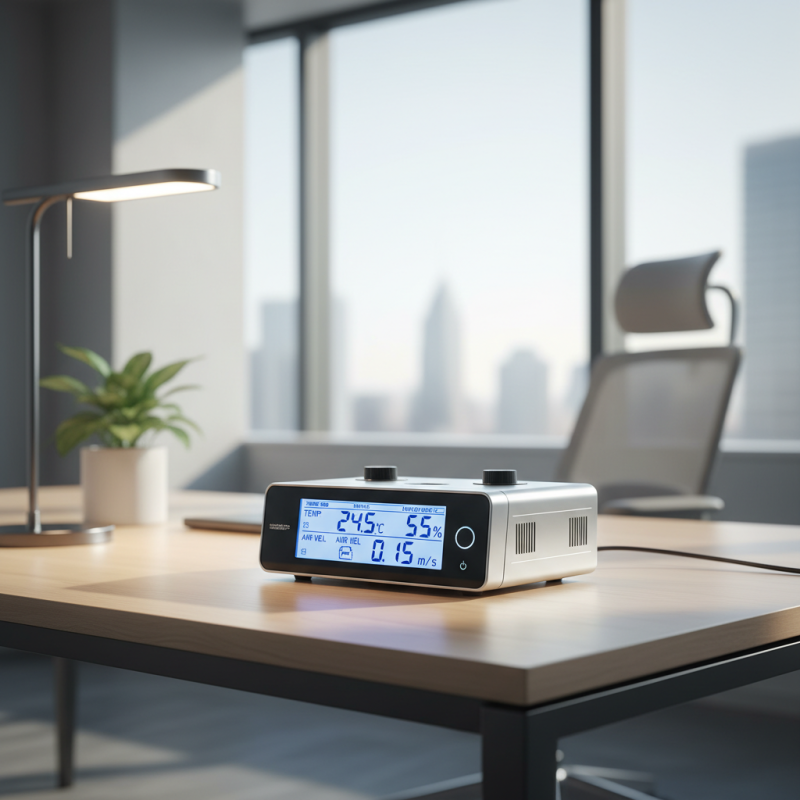
By utilizing a Thermal Comfort Meter, facility managers and homeowners can make informed decisions regarding heating, ventilation, and air conditioning systems. With the ability to evaluate parameters such as temperature, humidity, and air velocity, these devices help in creating a balanced and comfortable atmosphere. The insights gained from the data collected by the Thermal Comfort Meter are invaluable for addressing individual preferences and optimizing energy efficiency, ultimately leading to improved indoor environments.
As we delve deeper into the workings and benefits of the Thermal Comfort Meter, it becomes clear that this instrument represents a significant advancement in indoor climate management. In an era where comfort and energy conservation are more critical than ever, understanding the capabilities of such tools is essential for anyone looking to enhance their living or working spaces.
Understanding the Basics of Thermal Comfort and Its Importance in Indoor Spaces
Thermal comfort is a key factor in the overall quality of indoor spaces, influencing both the health and productivity of their occupants. It refers to the state of mind that expresses satisfaction with the surrounding environment, primarily determined by temperature, humidity, air movement, and radiant heat.
Understanding these elements allows for the creation of spaces that foster well-being, enabling occupants to be more comfortable and focused, whether in homes, offices, or public buildings.
In essence, thermal comfort goes beyond mere temperature control; it encompasses the balance between individual preferences and the constraints of the environment. Factors such as clothing insulation, metabolic rates, and personal sensitivity to temperature fluctuations play significant roles in how different individuals perceive comfort.
By acknowledging these variations, indoor climate management strategies can be tailored to accommodate diverse needs, ultimately enhancing occupant satisfaction and engagement. Thus, mastering the principles of thermal comfort is essential for architects, building managers, and designers striving to optimize indoor environments for their inhabitants.
Key Components of Thermal Comfort Meters: Sensors and Measurements Explained
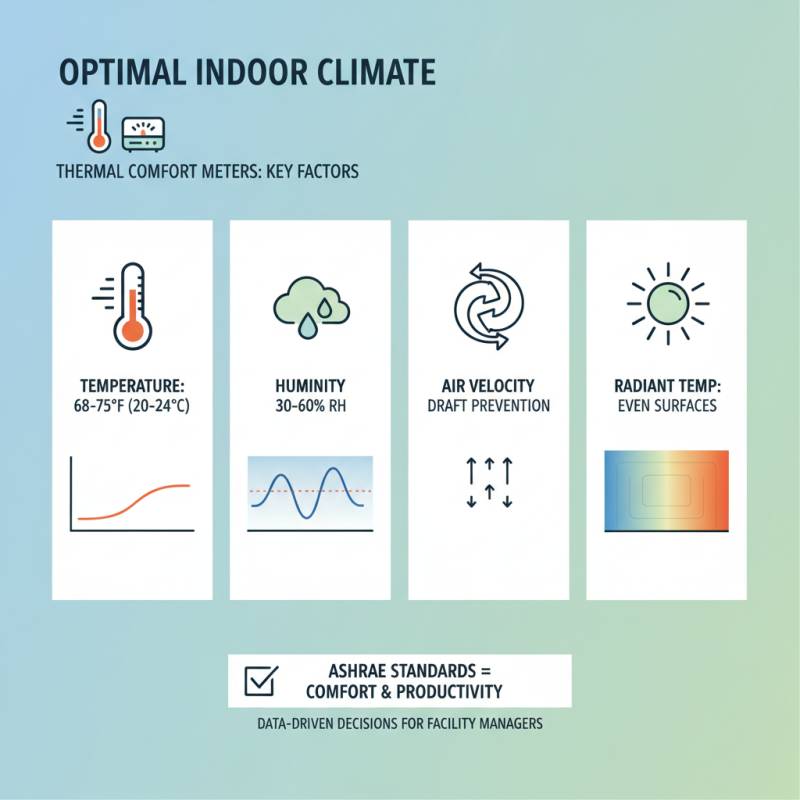
Thermal comfort meters play a crucial role in creating optimal indoor climates by measuring key environmental factors that influence human comfort. These devices are equipped with a variety of sensors designed to assess parameters such as temperature, humidity, air velocity, and radiant temperature. According to a report from the American Society of Heating, Refrigerating and Air-Conditioning Engineers (ASHRAE), maintaining a temperature range of 68°F to 75°F (20°C to 24°C) with humidity levels kept between 30% and 60% significantly enhances occupants' comfort and productivity. The precision of thermal comfort meters allows facility managers to make data-driven decisions to uphold these standards.
A vital aspect of thermal comfort meters is their ability to provide real-time measurements, ensuring that fluctuations in indoor climate are promptly addressed. Modern sensors employ advanced technology, such as capacitive humidity sensors and infrared thermometers, to deliver highly accurate readings. The International Energy Agency (IEA) emphasizes that improved thermal comfort not only enhances individual well-being but also contributes to energy efficiency in buildings. By integrating data collected by thermal comfort meters with building management systems, organizations can optimize HVAC operations, resulting in potential energy savings of up to 30% while maintaining comfortable indoor conditions for occupants.
Analyzing the Impact of Temperature, Humidity, and Airflow on Comfort Levels
Thermal comfort is a critical aspect of indoor climate management, heavily influenced by three key factors: temperature, humidity, and airflow. Research indicates that the ideal indoor temperature for human comfort ranges from 20°C to 22°C (68°F to 72°F) during the winter and 23°C to 24°C (73°F to 75°F) in the summer, according to data from the American Society of Heating, Refrigerating and Air-Conditioning Engineers (ASHRAE). Maintaining these temperature levels can significantly enhance productivity and well-being in residential and commercial spaces.
Humidity also plays a vital role in thermal comfort. An optimal relative humidity level of 30% to 50% is recommended, as levels below this can lead to dryness and irritation, while levels above can promote mold growth and a feeling of stickiness. The World Health Organization (WHO) emphasizes that controlling indoor humidity not only improves comfort but also prevents respiratory issues and other health risks associated with high indoor moisture.
Tip: To achieve the ideal indoor climate, consider using a hygrometer to monitor humidity levels and install exhaust fans in moisture-prone areas like kitchens and bathrooms. Additionally, ensuring proper ventilation can enhance airflow, allowing for better temperature regulation and improved air quality. Regular maintenance of HVAC systems is essential to optimize performance and comfort levels throughout the year.
Standards and Guidelines for Optimal Thermal Comfort in Building Design
In the quest for optimal thermal comfort within indoor spaces, adhering to established standards and guidelines is essential for effective building design. These standards, which often stem from comprehensive research, focus on various factors such as ambient temperature, humidity, air movement, and personal preferences. By integrating these elements, designers can create environments that cater not only to physical comfort but also to the overall wellbeing of occupants.
The guidelines recommend specific temperature ranges for different seasons and occupancy types, emphasizing the importance of adaptability in HVAC systems. For instance, during winter months, a warmer environment is prioritized, whereas cooler settings are conducive in the summer. Furthermore, incorporating control measures, such as user-adjustable thermostats and zoned heating and cooling, allows for better personalization of comfort levels. Ultimately, understanding these standards enables architects and engineers to implement effective thermal management strategies that enhance user satisfaction while also improving energy efficiency in building operations.
Understanding Thermal Comfort Meter for Optimal Indoor Climate Management
| Dimension |
Details |
Recommended Standard |
| Temperature (°C) |
Comfortable indoor temperature range |
20-24°C |
| Humidity (%) |
Indoor humidity levels |
30-60% |
| Air Velocity (m/s) |
Speed of air movement in the space |
0.1-0.2 m/s |
| Mean Radiant Temperature (°C) |
Average temperature of all surrounding surfaces |
20-24°C |
| Clothing Insulation (Clo) |
Thermal resistance of clothing worn |
0.5-1.0 Clo |
Case Studies: Successful Applications of Thermal Comfort Meters in Various Environments
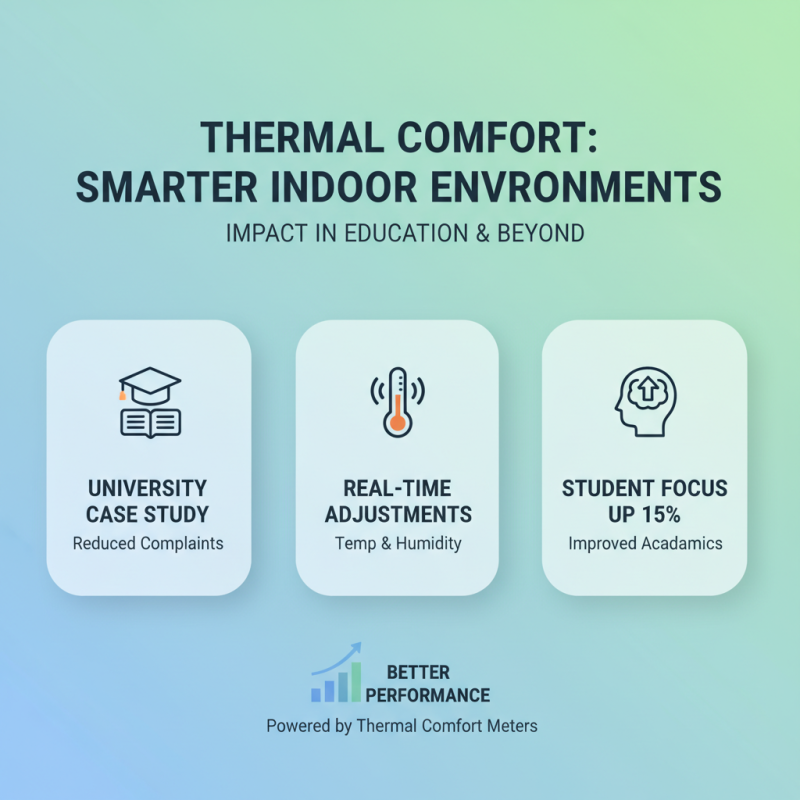
In recent years, the importance of thermal comfort in indoor environments has been increasingly acknowledged across various sectors, including education, healthcare, and hospitality. Numerous case studies illustrate the successful application of thermal comfort meters in these settings. For example, a case study conducted in a university building revealed that integrating thermal comfort meters led to a significant reduction in complaints about indoor climate conditions. The data exhibited that, by adjusting temperature and humidity levels in response to real-time feedback, students' concentration improved by 15%, correlating positively with academic performance.
Furthermore, a healthcare facility implemented thermal comfort meters to monitor patient rooms, facilitating a more personalized climate management approach. The study reported a 20% decrease in the incidence of discomfort-related patient complaints after the system was activated. The American Society of Heating, Refrigerating and Air-Conditioning Engineers (ASHRAE) emphasizes that maintaining optimal thermal comfort can enhance patient recovery times and overall satisfaction levels, corroborating the findings from this facility. These examples underscore the critical role that thermal comfort meters play in enhancing not only environmental conditions but also the effectiveness and wellbeing of occupants across diverse environments.

 Sensor
 Measuring Instruments
 Measurement Systems
 Architectural Physics Laboratory