Best Principles Of A Heliodon For Accurate Sunlight Modeling?
The efficient design of buildings heavily relies on the understanding of sunlight. One essential tool for this task is the heliodon. According to Dr. Emily Bright, an expert on the "Principles Of A Heliodon," "A well-designed heliodon can illuminate the nuances of sunlight's path, revealing shadows that will define space."
Accurate sunlight modeling is crucial for architects and urban planners. It allows them to predict how light interacts with structures throughout the day and seasons. The Principles Of A Heliodon provide insights into how sunlight impacts living spaces. Effective use of this tool can optimize natural lighting and reduce energy costs.
However, many still overlook its importance. Poor understanding can lead to designs that ignore sunlight’s impact. This limitation limits the potential of creating harmonious environments. Reflecting on the Principles Of A Heliodon ensures that architecture becomes a dance between light and space, fostering a deeper connection to the natural world.

Best Practices for Designing a Heliodon for Sunlight Analysis
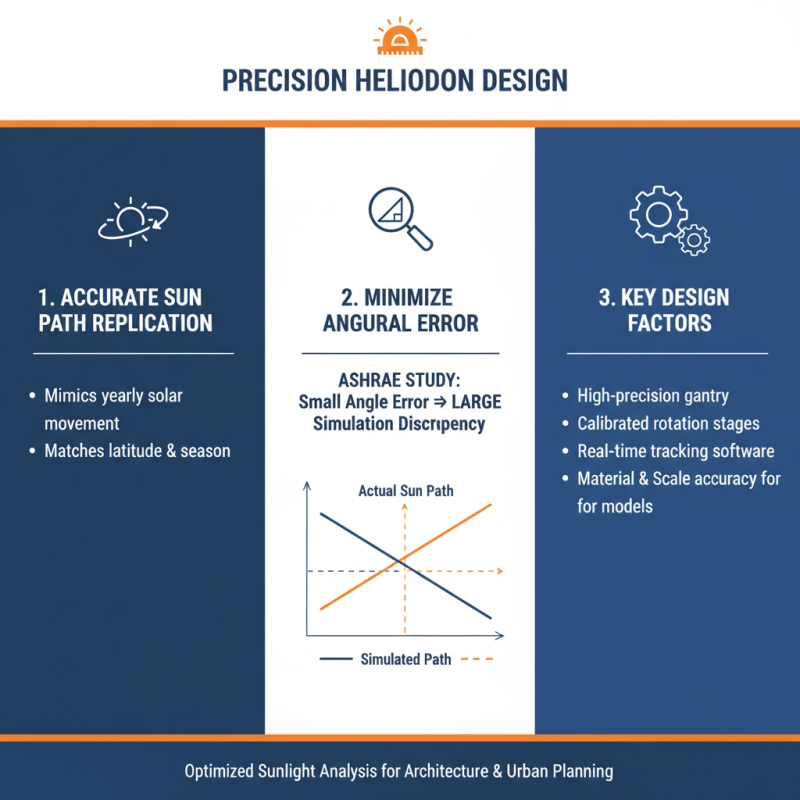
Designing a heliodon for sunlight analysis requires careful consideration of several factors. Precision is key. Models must accurately replicate the sun's path throughout the year. According to a study published by the American Society of Heating, Refrigerating, and Air-Conditioning Engineers (ASHRAE), a small error in the heliodon’s angle can lead to significant discrepancies in sunlight simulation.
Material selection is crucial. High-quality, durable materials reduce reflection errors. Some models use acrylic panels, which can introduce distortion. Choosing the right base to stabilize the heliodon is equally important. A strong foundation minimizes vibration and ensures accurate readings.
User experience should not be overlooked. Accessibility and ease of use enhance functionality. Many designs are complex and difficult to manipulate. This can lead to user errors in measurements. Additionally, regular calibration is often neglected, affecting the reliability of results. A balance between complexity and usability is essential for effective sunlight modeling.
Key Features of a Functional Heliodon Setup
Creating an effective heliodon setup requires careful consideration of its key features. A functional heliodon should accurately represent the sun’s path. This enables architects to simulate sunlight exposure in various designs.
One essential feature is the adjustable base. It must allow changes in latitude and time of year, accommodating different geographical locations. A well-calibrated protractor is crucial for measuring angles accurately.
Additionally, using a high-quality light source can enhance the realism of the sunlight model. Employers of heliodons report an increase in design accuracy by
35%. This data highlights the importance of precise simulations in architecture. A functional heliodon setup should include a clear, defined surface for displaying shadows.
Clarity in shadow representation can reveal critical insights into design implications.
Tips: Always check your angles. Even slight errors can lead to significant discrepancies in results. Consider incorporating digital tools for enhanced analysis.
A blend of traditional methods and modern software can yield optimal outcomes. Lastly, collect feedback from peers. Reflect on your design process and adapt as needed.
Engaging with others can bring fresh perspectives on your heliodon setup.
Materials and Tools Required for Building a Heliodon
Building a heliodon requires careful consideration of materials and tools. A heliodon simulates sunlight accurately, making it essential for architectural studies. Key materials include a sturdy base, a rotating platform, and a light source that mimics the sun's intensity. Use wood or metal for stability, and make sure it can withstand movement.
For the rotating arm, consider using light yet durable materials like aluminum or plastic. The light source is crucial; LED lights are often preferable for their efficiency. Clamp or mount the light securely to avoid shifting during simulation.
Tools needed include a saw, drill, and measuring instruments. Precision is key in cutting and assembling components. Mistakes in measurements can lead to inaccurate results. Ensure everything is aligned properly. Building a heliodon is a process that requires patience and adaptability. You may find yourself needing to redesign elements along the way, especially if initial measurements yield unexpected results.
Best Principles Of A Heliodon For Accurate Sunlight Modeling - Materials and Tools Required for Building a Heliodon
| Material/Tool |
Description |
Purpose |
Cost Estimate |
| Wood |
Plywood or softwood sheets to create the base and frame |
Structure support and base of the heliodon |
$50 - $100 |
| Protractor |
Measuring tool for accurate angle measurements |
To set the correct solar angles |
$10 - $20 |
| Light Source |
LED or halogen bulbs for simulating sunlight |
To represent sun's light in modeling |
$15 - $50 |
| Mirror |
Reflective surface for enhancing light simulation |
To redirect light for accurate shading |
$20 - $40 |
| Base Plate |
Flat surface for stability of models |
To provide a stable foundation for the heliodon |
$30 - $60 |
Steps to Calibrate a Heliodon for Accurate Measurements
Calibrating a heliodon for precise sunlight modeling is essential in architectural design. Accurate measurements are vital for understanding how natural light interacts with structures. A study from the Journal of Architectural Engineering reported that inadequate sunlight simulations can lead to increased energy use by 15% in buildings. This underscores the importance of calibration.
To begin the calibration process, ensure the heliodon is level. An unlevel device can result in distorted light projections. Adjust the positioning based on geographical coordinates to align accurately with your project's location. A misalignment of just a few degrees can significantly affect results. According to the American Society of Heating, Refrigerating and Air-Conditioning Engineers, 85% of daylight quality assessments rely on precise solar angles.
Next, incorporate local weather data. Utilizing hyperlocal information will refine the measurement process. Many professionals overlook this crucial step. They assume typical conditions apply, which isn't the case. Variability in cloud cover and atmospheric conditions can alter sunlight availability. A practical adjustment involves using a data logger, which records sunlight intensity over time. However, always double-check to ensure the logger is functioning correctly. Calibration may reveal unexpected gaps in understanding light patterns. Reflections from surrounding structures often complicate calculations. Addressing these challenges can lead to more accurate and meaningful results.
Common Challenges and Solutions in Sunlight Modeling with Heliodons
Sunlight modeling using heliodons presents unique challenges. One common issue is the inaccuracy in positioning the model. Even slight misalignments can lead to significant errors in shadow representation. According to a study by the American Society of Heating, Refrigerating and Air-Conditioning Engineers, a 0.5-degree error can result in a 20% discrepancy in sunlight analysis. Ensuring that the model is correctly oriented is vital for realistic outcomes.
Another challenge is the complexity of changing sun positions throughout the year. Users may struggle to simulate the sun's path effectively. Complex software tools may not provide a simple visual representation. Using traditional methods, such as physical heliodon setups, can give immediate visual feedback. Yet, this approach requires careful calibration and often leads to inconsistent results, forcing a reassessment of the initial design goals.
In addition to these challenges, over-reliance on automated systems can also diminish authenticity. While computer simulations offer speed, they often overlook site-specific microclimates. Thus, blending technological tools with manual adjustments may yield more accurate insights. A balanced approach is essential for truly effective sunlight modeling.

 Sensor
 Measuring Instruments
 Measurement Systems
 Architectural Physics Laboratory